

Articles
Key Insights
- AI is shifting analytics from reporting to real-time decision infrastructure. Organizations are moving beyond descriptive insights toward automated, adaptive systems that directly
- influence operational outcomes and strategic execution.
- Automation is materially improving productivity and speeding insight. AI-driven automation of data preparation, modeling, and experimentation is reducing development cycles and enabling faster deployment of analytics capabilities.
- Competitive advantages will shift toward organizations that operationalize and automate analytics. Firms that embed AI into core processes—such as risk management, customer engagement, and supply chain optimization—will outperform those that treat analytics as a standalone reporting function.
- Enterprise data platforms are evolving into AI platforms. Integrated environments that unify data management, machine learning pipelines, and generative AI capabilities are simplifying architecture and accelerating innovation.
- Governance and model risk management are now board-level concerns. As AI systems influence financial, operational, and customer decisions, oversight of transparency, bias, explainability, and regulatory compliance becomes critical.
AI is revolutionizing data science and analytics by fundamentally improving what practitioners can accomplish and, in some cases, shifting the role of the data scientist.
Automation of routine tasks is probably the most immediate impact. Tasks like data cleaning, feature engineering, and model selection—which used to take up most of a data scientist’s time—can now be largely automated through automated machine learning (AutoML) and AI-assisted pipelines. This allows more time for higher-level problem framing and interpretation.
Natural Language Querying (NLQ) make analytics more accessible. For example, tools like text-to-SQL and AI-powered BI platforms enable business users to query data in plain English, reducing the workload for technical staff. Someone without SQL skills can now ask, “What were our top-performing regions last quarter?” and receive a meaningful and detailed answer. Technologies such as Snowflake and Databricks offer multidimensional data analysis.
Speed
Faster and more efficient modeling is another breakthrough. Foundation models and transfer learning mean teams no longer need large, labeled datasets to build useful predictive models. LLMs also help in writing analysis code, creating documentation, and clarifying model outputs in simple language—thereby speeding up workflows.
Anomaly Detection
Anomaly detection and real-time analytics have improved significantly. AI systems can now monitor complex data streams and identify issues much faster than traditional threshold-based alerts, which is crucial for fraud detection, operations monitoring, and infrastructure management.
AI Has Challenges
AI presents new challenges: data quality and governance matter more than ever (garbage in, garbage out—now at scale), model interpretability is a growing concern, and there is an ongoing debate over bias and fairness in automated decision-making.
The Data Scientist
The role of the data scientist is evolving from someone who constructs models to someone who supervises, interprets, and manages AI systems—becoming more strategic and less purely technical. Some basic analysis tasks are being consolidated, while demand grows for people who can link AI capabilities with business judgment. For those involved in technology strategy and enterprise architecture (as often seen in consulting), the main change is that AI is transforming analytics from just a tool for analysts into an essential operational capability integrated into business processes.
Data Science Lifecycle
The Data Science Lifecycle is a structured framework that describes the repetitive process data scientists follow to extract value and insights from data. While variations exist across organizations and frameworks, such as CRISP-DM and TDSP. [1, 2]
CRISP-DM
The Cross-Industry Standard Process for Data Mining (CRISP-DM) is one of the oldest and most widely used frameworks for data science and data mining lifecycles. It was originally created in the late 1990s by a group of companies, including IBM, Daimler, and SPSS. [2]
![Table 1 CRISP-DM Lifecycle[2] 2](https://greenleafgrp.com/wp-content/uploads/2026/03/Screenshot-2026-03-31-153415-800x416.png)
The lifecycle is iterative rather than linear — findings at any stage often send the team back to an earlier one. Artificial Intelligence is significantly automating many of the technical tasks traditionally performed by data scientists.
TDSP
Team Data Science Process (TDSP) is a modern, agile framework created by Microsoft for collaborative, team-based data science projects in enterprise settings. Combining aspects of Scrum and CRISP-DM yields a process similar to Microsoft’s Team Data Science Process. Introduced in 2016, TDSP is described as “an agile, iterative data science methodology to deliver predictive analytics solutions and intelligent applications efficiently.” The approach is more streamlined, using five phases instead of eight, compared to CRISP-DM. [3]
![Table 2 - TDSP Phasing [3]](https://greenleafgrp.com/wp-content/uploads/2026/03/Table-2--800x312.png)
![Figure 1 - Team Data Science Lifecycle [3]](https://greenleafgrp.com/wp-content/uploads/2026/03/Picture1-800x547.jpg)
Automated Machine Learning Engineering Tools
New technology provides automated feature engineering capabilities.
- Automated model selection and hyperparameter tuning
- AI-assisted coding through systems such as GitHub Copilot.
- Rapid experimentation with hundreds of candidate models.
These tools:
- Reduce the time needed to develop models
- Lower barrier to entry for non-specialists
- Allow data scientists to focus increasingly on problem framing, data quality, and governance rather than on algorithm construction.
Predictive Analytics to Generative and Cognitive Analytics
AI advances new analytic paradigms and opportunities. Traditional analytics focused on predicting outcomes. AI now enables generative and reasoning capabilities (see Table 1).

Large language models like ChatGPT and Claude enable analysts to communicate and work in natural language rather than SQL or Python. This capability enables business users to more effectively engage with the data analysis process and actively engage in problem-solving.
Natural Language Interfaces to Data
AI is making it significantly easier for people of various skill levels to access data science and analytical systems. These tools provide:
- Text-to-SQL query generation
- Conversational data exploration
- Automated report generation
- AI-generated dashboards and narratives
Platforms such as Tableau1 and Microsoft Power BI2 now embed natural language query engines. Snowflake and Databricks, discussed in more detail below, also provide charts and graphs using Natural Language Querying (NLQ).
Analytics is shifting from specialist-led workflows to organization-wide decision platforms.
Synthetic Data and Data Augmentation
AI can generate synthetic datasets to address limitations in real-world data. Synthetic data is especially important in regulated industries like financial services and healthcare, where access to real-world data is restricted. Synthetic data provides high degrees of valid analysis results:
- Privacy-preserving data sharing
- Rare event modeling
- Medical research datasets
- Fraud detection training data
See my previous articles on data in the Life Sciences [4] and Financial Services Industry [5].
AI-driven Data Engineering
AI is increasingly used in data preparation and pipeline management, which has historically accounted for 30% to 75% of data science efforts3. [6-8]
Examples include:
- Automated Schema Mapping
- Data Quality Anomaly Detection
- Intelligent Data Cataloging
![Figure 2 : Most Time Consuming Tasks[7]](https://greenleafgrp.com/wp-content/uploads/2026/03/Picture2-800x276.png)
AI Governance
For enterprise organizations, the rapid progress of AI is leading to a new field: AI governance architecture. At the heart of this change is the growing role of the data scientist, whose tasks are expanding beyond their traditional focus on statistical modeling, algorithm selection, and data cleaning. Today’s data scientists are increasingly asked to tackle higher-level challenges — defining the right problems, applying deep domain expertise, and designing decision systems that combine human judgment with machine intelligence. Importantly, they are also taking on the role of stewards of model governance, ensuring that AI systems remain transparent, accountable, and aligned with organizational values. This shift reflects a broader understanding that creating effective AI isn’t just a technical effort, but a sociotechnical one — requiring data scientists to work at the crossroads of technology, ethics, and business strategy.[9]
Convergence of AI, Data Platforms, and Analytics
The rapid advancement of artificial intelligence is leading to a merging of data platforms, machine learning infrastructure, and analytics systems. Traditionally, organizations kept separate platforms for data warehousing, machine learning experiments, and operational analytics. Today’s AI platforms combine these layers into unified environments that support the entire data-to-decision process.
Two of the most influential platforms shaping this architecture are Snowflake and Databricks. Both platforms offer integrated environments that combine large-scale data storage, distributed computing, machine learning pipelines, and increasingly, generative AI capabilities.
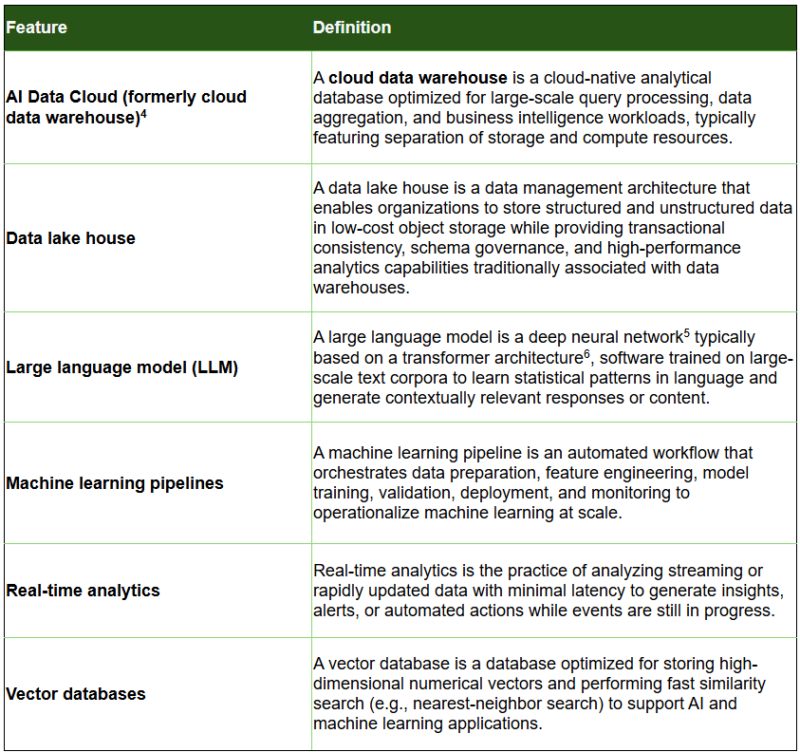
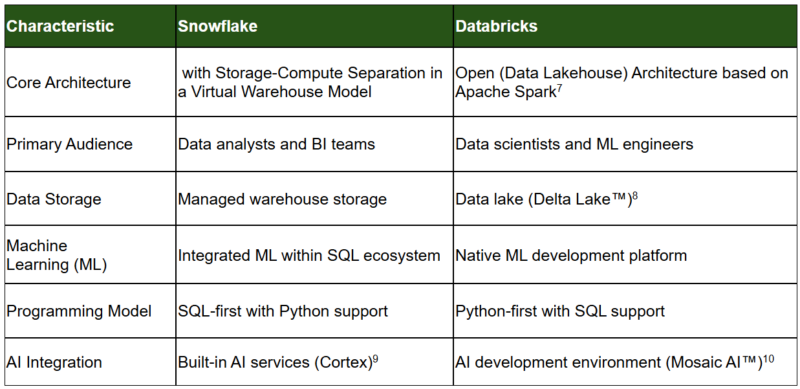
The platforms have different philosophies, described by closed/managed vs. open/flexible. Snowflake optimizes for simplicity, concurrency, and SQL performance out of the box. Databricks optimizes for flexibility, openness, and the full data+ML lifecycle — but at the expense of operational complexity.
In practice, many organizations use both platforms:
- Snowflake for enterprise analytics and data sharing
- Databricks for large-scale machine learning and AI model development
Conclusion
AI is fundamentally transforming analytics architectures, turning data platforms into integrated, AI-powered environments that handle structured, semi-structured, and unstructured data, including streaming data, while supporting the entire machine learning lifecycle. These platforms enhance accessibility with natural language interfaces—such as conversational analytics and text-to-SQL—and incorporate governance features like data lineage, model oversight, and regulatory compliance directly into the infrastructure. The result is a unified system where data ingestion, AI model development, and operational decision-making work together within a single, cohesive architecture.
Strategically, this shift indicates a move from viewing analytics as a support role to making it a central part of operations. Success is now judged not just by access to data but by the ability to deploy insights reliably, at scale, and with proper governance. Organizations that naturally align their data platforms, AI tools, and decision-making processes—rather than keeping them separate—will be better positioned to simplify their architecture, reduce AI risks, and deliver measurable business results.
About Green Leaf
Green Leaf Consulting Group offers practical experience in helping financial organizations leverage data for risk management, customer analytics, digital transformation, strategic decision-making, and AI-driven innovation.
References
- Wirth,R.and J. Hipp. CRISP-DM: Towards a standard process model for data mining. in 4th International Conference on the Practical Applications of Knowledge Discovery and Data Mining. 2000.
- Chapman, P.,CRISP-DM 1.0: Step-by-step data mining guide. 2000, SPSS: Netherlands.
- PM, D.S.,What isTDSP?, in Data Science PM. 2025, Data Science PM: https://www.datascience-pm.com/tdsp/.
- Ferrara, E.,Data in the Evolving World of Life Sciences: Chaos to Order, inGreenleaf Group – Insights, M. Miner, Editor. 2025, Greenleaf Group: https://greenleafgrp.com/insights/data-in-the-evolving-world-of-life-sciences-chaos-to-order/.
- Ferrara, E.,Risk, Regulation, and Trust: Why Data Governance Defines Leadership in Banking and FinTech, inGreenleaf Insights, M. Miner, Editor. 2026: https://greenleafgrp.com/insights/risk-regulation-and-trust-why-data-governance-defines-leadership-in-banking-and-fintech/.
- Crowdflower,Data Science Report. 2016:https://www2.cs.uh.edu/~ceick/UDM/CFDS16.pdf.
- Anaconda,2023-State of Data Science Report— Ai Takes Center Stage. 2023:https://www.anaconda.com/wp-content/uploads/2025/12/Anaconda-2023-State-of-Data-Science-Report.pdf.
- Anaconda,8th Annual State of Data Science & AI Report How Companies Are Moving Ahead—Or Not—In the AI Race. 2025:https://www.anaconda.com/wp-content/uploads/2025/12/Anaconda-2023-State-of-Data-Science-Report.pdf.
- Clegg, N., et al.,AI Governance Alliance: Briefing Paper Seriesin AI Governance Alliance: Briefing Paper Series 2024.