

Articles
Preface
Part 1 of this series argued that a mid-market carrier doesn’t need a data-science team or a new policy administration system (PAS) to realize real value from AI; it needs four things: a governed data layer with known lineage, bounded workflows where failure is visible, human oversight with genuine override authority, and an audit trail from the first day in production. [1]
That piece deliberately stopped short of naming a data platform. The advice was to choose a governed data layer aligned with your first two or three workflows, then focus on AI enablement for each to ensure a methodical, risk-balanced approach. That was the right call for a piece about sequencing, but it left the most common follow-up question unanswered: which layer?
For most mid-market insurers, the shortlist narrows to two names—Snowflake and Databricks—and the choice between them is where an otherwise sound strategy often runs into trouble. This paper picks up from there, outlining how to decide between the two and, just as important, how to make either platform produce the evidence an examiner will ask for to stay in good standing with regulators.
Key Insights
- The platform is a means, not the end. The governed data layer exists to support the first two or three workflows and to produce regulatory evidence. Choose the platform that fits your team and workflows, not the one with the longest feature list [2]
- Snowflake and Databricks have converged on governance. Both now ship with built-in governance and lineage layers — Snowflake’s Horizon Catalog and Databricks’ Unity Catalog — that track column-level lineage, classify sensitive data, monitor data quality, and govern AI assets using the same access model as the data [3], [4].
- The real difference is operating model, not capability. Snowflake optimizes SQL-first teams and low operational overhead; Databricks offers more control and power for engineering- and ML-heavy work but requires more management [5].
- For a mid-market carrier, cost is rarely the deciding factor. Across typical mid-market volumes, the platforms land within a similar cost band; the expensive mistake is choosing the wrong fit and migrating two years later [6].
- Governance is not all in the base price. On Snowflake, lineage, data-quality monitoring, and sensitive-data classification require Enterprise Edition; on Databricks, they depend on Unity Catalog being configured before data lands. Budget and design for governance up front [7], [8].
- Either platform can satisfy the NAIC evidence test — if you turn the features on. Lineage, access history, and model governance exist in both, but they produce examiner-ready evidence only when configured from day one, not retrofitted [9].
From Data Platform to Decision Engine
As AI moves into core carrier workflows, the data platform stops being a passive warehouse and becomes the place where governed data, models, and decisions converge. That shift is why the platform choice matters more than it used to: the same system now holds the data an underwriter relies on, the lineage an examiner will request, and, increasingly, the models and retrieval systems that generate the answer. We made the broader case in AI Is Turning Data Platforms into Decision Engines [2].
It is also why the decision to implement an AI model should follow the workflow, not lead it. Part 1’s sequencing argument still holds: name the first workflow and its owner, trace its inputs, and only then choose where that data will live and be governed [10]. Midsize carriers are already putting roughly a third of their transformation budgets into data infrastructure and analytics, in recognition that data quality and governance must precede AI scaling [10]. The platform decision is how that budget gets spent well or poorly. The wall that stops most carriers short of enterprise-wide adoption is not the model — it is the data and governance plumbing around it [11], [12].
What a Governed Data Layer Must Do for an Insurer
Before comparing vendors, fix the evaluation criteria to what an insurer needs. Part 1 defined a governed layer as one that can answer four questions about any field an AI system touched: where it came from, when it arrived, what transformed it, and whether its structure has changed [11]. For a regulated insurer, four more requirements sit on top of that.
- Column-level lineage, end to end. Not just table-to-table, but field-level traceability from the source document or feed through every transformation to the model input and the decision — the lineage the NAIC bulletin tells insurers to expect regulators to request [9].
- Sensitive data classification and masking. Automatic discovery and tagging of PII, with masking and row-level controls that follow the data into AI workloads rather than being bolted on at the application layer.
- Quality and drift monitoring. Continuous checks on freshness, completeness, and distribution so a renamed column or a shifted feed is caught before it reaches a model.
- One access and audit model for data and AI. The same permissions, lineage, and audit log cover tables, models, prompts, and retrieval indexes — so an AI application cannot read what its user could not, and every answer traces back to governed data [14].
These are the dimensions on which Snowflake and Databricks should be judged. Both clear the bar; they clear it differently.
Snowflake: Governed SQL, Low Operational Overhead
Snowflake’s governance and discovery capabilities are consolidated in the Horizon Catalog, built into the platform rather than purchased separately. Horizon provides metadata search, automatic sensitive-data classification, column-level lineage across Snowflake and external sources, data-quality monitoring, and AI governance under one control plane [3]. Lineage traces data flows from ingestion through transformation to consumption and traces an AI-generated answer back to the source rows that produced it [3].
Snowflake’s defining characteristic for a lean team is operational simplicity. It abstracts most platform operations, prices compute as credits against warehouse runtime plus storage, and is strongest for SQL-first analytics and governed data marts — the shape of work most mid-market carriers already do [5], [6]. Its AI layer, Cortex, adds LLM functions and document processing that fit the first insurance workflows in Part 1’s list: reading submissions, loss runs, and first-notice-of-loss documents.
The practical caveat is editions. Snowflake’s lineage, data-quality monitoring, and sensitive-data classification require Enterprise Edition or higher, and that edition applies to every credit the account consumes, not only to governance queries [7]. For an insurer, Enterprise Edition is effectively the floor, and the budget should assume it from the start.
Databricks: More Control, More Power, More to Manage
Databricks approaches the same problem from the lakehouse side. Its governance layer, Unity Catalog, is a single place to control access, track lineage, discover assets, monitor quality, and govern AI across data and models [4]. Unity Catalog captures lineage automatically across tables, views, and volumes and across notebooks, jobs, models, and dashboards, down to the column level, and retains that lineage for one year — a useful default for an audit trail [8]. Its AI layer, Mosaic AI, serves models and retrieval behind the same governance boundary, with guardrails and model lineage managed through Unity Catalog, so an AI application inherits the access rules of the data it reads [14].
The trade-off is operational. Databricks gives more control over compute, pipelines, and data layout, which is exactly what a team doing heavy ML, streaming, or large-scale transformation wants — and exactly what a two-person data team does not want to administer [5]. Its DBU-based pricing is also harder to model than Snowflake’s warehouse credits, so cost governance becomes its own discipline. For a mid-market carrier whose first workflows are document extraction and triage rather than custom model training, much of that power can sit unused.
One design point applies to both platforms but bites harder on Databricks: governance must be configured before data lands. Retrofitting permissions and lineage onto a populated environment is the expensive path [4].
Choosing Between Them
For a mid-market insurer, the decision rarely turns on raw capability, both platforms clear the governance bar, and rarely on price, since typical volumes land the two within a similar cost band[6]. It turns on fit. The table below frames the dimensions that matter.
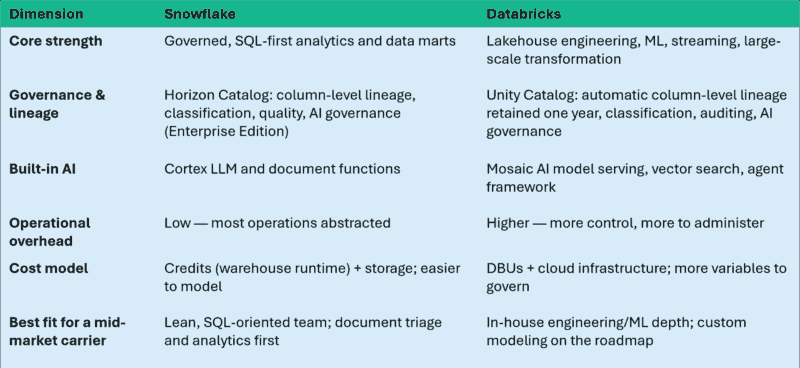
The honest summary: a mid-market carrier with a small, SQL-literate team and a first wave of document-reading workflows will usually reach production faster on Snowflake. A carrier with real data-engineering depth, or a near-term plan to train and serve its own models, will get more headroom from Databricks. Many large enterprises run both; a mid-market carrier should resist that until a second workflow genuinely demands it. The costliest decision is not Snowflake-versus-Databricks — it is forcing one platform to do a job it is poorly suited to, then migrating [6].
Making Either Platform Examiner-Ready
Part 1’s central regulatory point was that the NAIC Model Bulletin frames AI oversight as an evidence problem: an examiner asks what is in production, how it was tested, how it has been monitored, and how you vetted any vendor model you rely on[9]. Both platforms can produce that evidence — but only if the governance features are enabled and configured from the first deployment.
- What is in production. Use the catalog — Horizon or Unity — as the living inventory of governed datasets, models, and the AI assets that consume them, rather than a spreadsheet maintained by hand.
- How it was tested and monitored. Capture the pre-deployment baseline and the ongoing quality and drift metrics in the platform’s monitoring, so the performance history exists when it is requested[9].
- Lineage on demand. Column-level lineage and access history provide the field-level traceability and the record of who touched what — the documentation the bulletin anticipates[3], [8].
- Vendor and model due diligence. Govern third-party and in-house models under the same access and lineage model as the data, so reliance on a vendor model is itself documented.
The pattern is the one Part 1 insisted on: the audit trail is not hygiene added later, it is the deployability requirement. The platform makes it cheap to record — if you turn it on before the first workflow goes live, not after an examiner asks.
The Platform-Selection Skip List
- A platform bake-off before you have a workflow. Choose for the first two or three workflows you are actually deploying. The evaluation criteria come from the work, not from a vendor’s feature grid.
- Running both to hedge. Two governance models, two cost models, and two skill sets is the wrong overhead for a mid-market team. Start with one.
- The enterprise data lake build-out. Scope the governed layer to the workflows in flight and expand it when the next workload earns it; this is the same discipline Part 1 prescribed [1].
- Buying the AI tier before the data tier works. Cortex and Mosaic AI are only as trustworthy as the governed, lineage-tracked data beneath them. Sequence accordingly.
- Waiting for core replacement to pick a platform. The governed layer reads from the core today and survives the eventual migration; it is not a reason to wait, and the cost of staying on legacy is real enough without adding AI paralysis to it [13].
A Platform-Selection Readiness Check
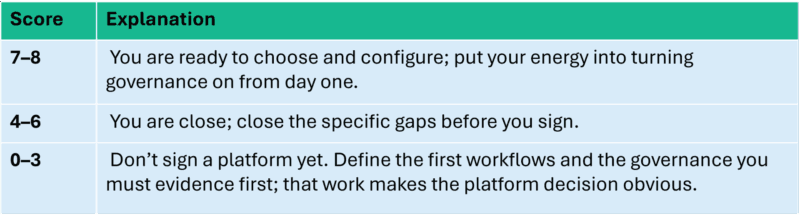
Give yourself one point for each honest yes.
- Can we name the first two or three workflows the platform has to serve?
- Do we know, for those workflows, whether the work is mostly SQL analytics or mostly data and ML engineering?
- Have we sized the team that will operate the platform, and been honest about how much it can administer?
- Have we budgeted for the edition and configuration that governance actually requires, not just base compute?
- Will lineage, classification, and quality monitoring be configured before the first data lands?
- Can the platform produce a current inventory of AI systems and the data they read?
- Will model and vendor governance sit under the same access model as the data?
- Do we know which of our states’ regimes set the strictest evidence bar we must design to?
Conclusion
The platform question feels like the hard part, and vendors are happy to keep it that way. For a mid-market carrier, it is more tractable than it looks. Snowflake and Databricks have converged on the governance capabilities an insurer needs — column-level lineage, sensitive-data classification, quality monitoring, and a single access model spanning data and AI. The decision is about fit: a lean, SQL-first team deploying document workflows will usually move faster on Snowflake, while a carrier with engineering depth and a modeling roadmap will get more from Databricks. Either way, the capability that matters most is the one you have to enable from the first deployment: governance and lineage, so the system produces examiner-ready evidence as a byproduct of running rather than as a scramble when an examiner calls [14]. That, not the logo on the invoice, is what turns a data platform into a decision engine a regulated carrier can actually deploy [2].
Green Leaf Group has strong expertise in both, with certified engineers who can help you get the most out of this technology investment.
References
[1] E. Ferrara, “Which AI Workloads Should You Build? A Risk-Based Prioritization Framework,” Green Leaf Insights, Green Leaf Group, 2026. [Online]. Available: https://greenleafgrp.com/insights/which-ai-workloads-should-you-build-a-risk-based-prioritization-framework/.
[2] E. Ferrara, “Artificial Intelligence is Turning Data Platforms into Decision Engines,” Green Leaf Insights, Green Leaf Group, 2026. [Online]. Available: https://greenleafgrp.com/insights/ai-is-turning-data-platforms-into-decision-engines/.
[3] Snowflake, “Snowflake Horizon Catalog,” 2026. [Online]. Available: https://docs.snowflake.com/en/user-guide/snowflake-horizon.
[4] Databricks, “Data Governance with Databricks,” Databricks Documentation, 2026. [Online]. Available: https://docs.databricks.com/aws/en/data-governance.
[5] Tarento, “Snowflake vs Databricks: Choosing the Right Enterprise Data Platform in 2026,” 2026. [Online]. Available: https://www.tarento.com/articles/snowflake-vs-databricks-enterprise-data-platform-comparison/.
[6] Modern Data Tools, “The Real Cost of Snowflake vs Databricks vs BigQuery in 2026,” 2026. [Online]. Available: https://www.modern-datatools.com/blog/real-cost-snowflake-databricks-bigquery-2026.
[7] J. S, “Is Snowflake Horizon Enough, or Do You Need a Dedicated Catalog?,” DeCube Insights, DeCube.io, 2026. [Online]. Available: https://www.decube.io/post/snowflake-horizon-vs-dedicated-data-catalog.
[8] Atlan, “7 Databricks Data Lineage Best Practices for 2026,” 2026. [Online]. Available: https://atlan.com/know/databricks-data-lineage-best-practices/.
[9] National Association of Insurance Commissioners, “NAIC Model Bulletin: Use of Artificial Intelligence Systems by Insurers,” NAIC, 2023. [Online]. Available: https://content.naic.org/sites/default/files/call_materials/Model%20Bulletin%2010.23%20Clean.pdf.
[10] J. Staten, “Make The Cloud Enterprise Ready,” Forrester Research, 2012.
[11] National Association of Insurance Commissioners, “Insurance Topics | Artificial Intelligence,” 2026.
[12] J. Krantz, “AI Implementations in 2026: The Pilot Phase Is Over for Life/Annuities Group Benefit Carriers,” Datos Reports, Datos, 2026. [Online]. Available: https://datos-insights.com/reports/ai-implementations-in-2026-ins-2026-102370/.
[13] Green Leaf Group, “The Hidden Cost of Staying on Legacy Systems in 2026,” Green Leaf Insights, 2026. [Online]. Available: https://greenleafgrp.com/insights/the-hidden-cost-of-staying-on-legacy-systems-in-2026/.
[14] E. Ferrara, “Enterprise AI Governance Framework: Regulatory Readiness, Risk Management, and Compliance in 2026,” Green Leaf Insights, Green Leaf Group, 2026. [Online]. Available: https://greenleafgrp.com/insights/enterprise-ai-governance-framework-regulatory-readiness-risk-management-and-compliance-in-2026/.
[15] J. Gibbs, “AI Update: NAIC Launches Multi-State Pilot of AI Systems Evaluation Tool,” Zelle Law, 2026. [Online]. Available: https://www.zellelaw.com/AI_Update_NAIC_Launches_Multi-State_Pilot_of_AI_Systems_Evaluation_Tool.