

Articles
AI Governance & Security Playbook
Part 1, Regulatory Readiness & Governance Architecture
Key Insights
- Governance architecture, not prohibition, is the only durable response. Blanket AI bans are unenforceable and push usage underground, eliminating the visibility organizations need to manage risk. The productive path combines technical controls, a published acceptable-use policy, vendor accountability, and board-level risk reporting. [2]
- AI governance is inseparable from data governance. The trustworthiness of any AI system is only as strong as the quality, lineage, and controls of the data it depends on. Organizations cannot govern AI effectively without first governing the data that trains, tests, and operates it. [3][3]
- Regulatory pressure is mounting on both sides of the Atlantic. More than 1,000 AI-related bills were introduced across U.S. states in 2025, and multiple state laws took effect on January 1, 2026. In Europe, the EU AI Act remains the global benchmark; under the Digital Omnibus agreement of May 2026, high-risk obligations for stand-alone systems are now scheduled to apply from December 2, 2027, with penalties of up to €35 million or 7% of global turnover for the most serious breaches. [4, 5]
- A layered standards framework is the most practical path forward. Combining the NIST AI Risk Management Framework for risk management, ISO/IEC 42001 for systematic AI management, ISO/IEC 27001 for information security, and EU AI Act requirements provides organizations with a structured, extensible foundation that reduces fragmentation across jurisdictions. [6, 7]
- Governance is a competitive differentiator, not just a compliance cost. Organizations classified as “AI Masters,” those with advanced data governance and infrastructure, achieved roughly 24% higher revenue growth than less-mature peers, demonstrating that governance delivers measurable business value. [8]
- The vendor you procure may be your largest control gap. IP indemnification, data isolation, administrative controls, and training opt-outs are enterprise-tier capabilities absent from consumer accounts across every major AI provider. Vendor assessment and registry management are essential governance controls, not optional add-ons. [2]
Introduction
Large language models (LLMs) and specialized small language models (SLMs) have rapidly evolved from research curiosities into essential workplace tools. Across every function, from legal and finance to engineering and marketing, employees now routinely use AI assistants to draft documents, analyze data, summarize research, and accelerate decision-making. The productivity dividend is real and measurable. [1]
What is less well defined and more urgently needed is the organizational response. Most senior leaders understand that AI delivers significant gains while exposing valuable intellectual property; the problem is that the technical controls, policies, and governance structures required to manage that exposure are not yet mature, or, in many organizations, do not yet exist. Companies that intend to use AI safely need a strong adoption, governance, and compliance framework to guide management and staff.
This playbook provides that framework, organized around four interconnected disciplines: regulatory readiness; a proactive governance architecture; a redesigned security awareness program; and a well-defined technical defense. None works in isolation; technical controls erode without a governance body to own them, policies go unread without training, and awareness cannot compensate for weak defenses. Part 1 develops the first two disciplines in depth. The goal is not perfection but measurable improvement that makes safe AI use the path of least resistance, because you get what you measure. [9]
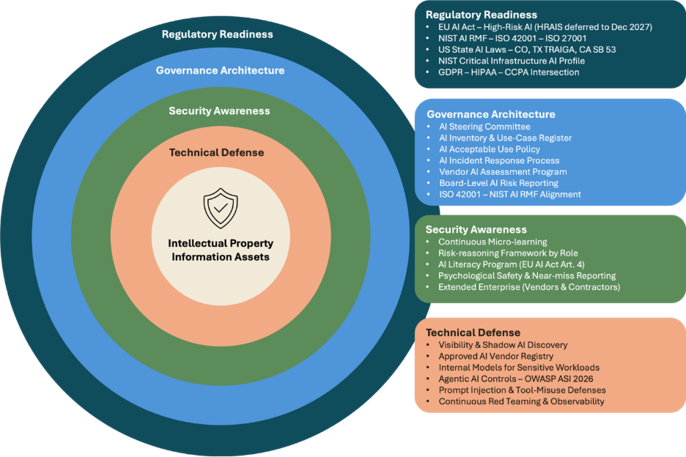
Step 1: Regulatory Readiness
The U.S. artificial-intelligence regulatory landscape in 2026 is defined by a complex, evolving patchwork of state laws, absent comprehensive federal legislation. At the federal level, the Trump Administration has adopted a deregulatory approach, revoked Biden-era AI safety requirements, and signaled its intent to preempt inconsistent state laws. States, meanwhile, have moved aggressively to fill the void, enacting targeted measures addressing AI use in employment, healthcare, consumer protection, and other domains. Risk and compliance leaders should proactively review all applicable standards, recognizing that the list of state regulations will continue to evolve.
U.S. State Law
Multiple state AI laws took effect on January 1, 2026, including in California, Illinois, New York, and Texas, with Colorado’s comprehensive AI Act following on June 30, 2026. More than 1,000 AI-related bills were introduced across the states in 2025 alone, up from more than 700 the prior year, signaling continued legislative momentum and a durable patchwork that multistate employers must track. [4]
Federal Law and Regulation
Congress has yet to pass meaningful AI legislation, but the President has issued two executive orders. On January 20, 2025, the Administration revoked Executive Order 14110 on AI safety. [10] On December 11, 2025, it signed “Ensuring a National Policy Framework for Artificial Intelligence,” which proposes to preempt state AI laws deemed inconsistent with federal deregulatory policy and directs the Attorney General to establish an AI Litigation Task Force to identify and challenge such laws. The result is a looming federal-versus-state showdown over preemption. [11]
As of June 2026, a new bipartisan proposal is before the House of Representatives. [12] Key provisions of the proposal include:
- Development of a Federal AI governance framework
- AI whistleblower protection
- Increased penalties for AI-enabled fraud
- AI literacy and workforce programs
- Limited federal preemption of certain state AI regulations
- Restrictions on states’ regulation of foundation-model development and pre-release testing, while preserving much of the states’ authority over AI deployment and use.
However, the path to full passage will be difficult. This is not the first attempt by Congress to pass AI legislation. A bill to ban state oversight of AI in 2025 failed in the US Senate. [13]
Sector-Specific U.S. Obligations
Healthcare. The HIPAA Security Rule applies to AI. Covered entities must conduct a thorough risk analysis before adopting AI tools; sharing protected health information with a vendor almost always requires a Business Associate Agreement, and HIPAA remains the baseline for any AI system handling PHI.[14]
Financial services. The Fair Credit Reporting Act covers AI-driven credit scoring, tenant screening, and background checks, with adverse-action notice obligations when AI influences credit or employment decisions. The CFPB has moved to clarify Equal Credit Opportunity Act / Regulation B obligations relevant to AI lending models that may produce discriminatory outcomes. [15, 16]
Securities and consumer protection. The SEC targets transparency, conflicts of interest, and “AI washing,” with 2026 examination priorities emphasizing material, company-specific disclosure. Many states apply Unfair or Deceptive Acts or Practices statutes to AI decisions, and the FTC continues to investigate deceptive AI claims, privacy violations, and algorithmic pricing. [17]
Corporate Response
Several companies, notably xAI and the National Retail Federation, have filed legal challenges to state AI laws, and the DOJ has intervened in litigation over Colorado’s algorithmic-discrimination statute. Those cases are only beginning to move through the courts. Until courts rule otherwise, state AI laws remain enforceable, and companies must act to comply.[18]
Europe and the EU AI Act
The EU AI Act (Regulation 2024/1689) is the world’s first comprehensive legal framework for AI. It entered into force on August 1, 2024, and classifies AI systems into four risk tiers (unacceptable, high, limited, and minimal), with fines of up to €35 million or 7% of annual global turnover for the most serious violations. U.S. companies operating high-risk systems that affect people in the EU may also fall within its scope. [5]
The implementation timeline shifted materially in 2026. Prohibitions on unacceptable-risk practices took effect in February 2025, and general-purpose AI model transparency obligations took effect in August 2025. Under the Digital Omnibus agreement reached on May 7, 2026, the bulk of high-risk obligations for stand-alone Annex III systems, covering biometrics, critical infrastructure, education, employment, and essential services, are now scheduled to apply from December 2, 2027, with systems embedded in regulated products following on August 2, 2028. The deferral reflects delays in finalizing harmonized standards; it is a postponement, not a dismantling, and the Act’s risk-based architecture remains intact. Organizations should continue their classification and conformity work against these dates. [5]
The GDPR Intersection
The General Data Protection Regulation remains central to AI adoption. Because AI consumes vast amounts of information, some of it personally identifiable or sensitive, the intersection of the AI Act and the GDPR is significant. Both use a risk-based approach but rest on different logics: the AI Act is fundamentally a product-safety regulation focused on organizational design and system safety, while the GDPR protects fundamental rights in relation to personal data. Both must be addressed, and compliance work for one can only be partially leveraged for the other. [19]
Standards as a Regulatory Bridge
When binding law is fragmented, voluntary standards provide a common language. NIST’s AI Risk Management Framework and ISO/IEC 42001 have become de facto governance benchmarks, cited in vendor due diligence and regulatory examinations. Alignment with these standards is increasingly treated as evidence of reasonable care. Sector regulators, including the CFPB, FDA, SEC, FTC, and EEOC, now cite NIST AI RMF principles in their expectations for safe deployment. (Step 2 builds on these standards as the foundation of the governance architecture.) [6, 20, 21]
In December 2025, CISA and its international partners published joint guidance on securely integrating AI into operational-technology environments, outlining four steps: Understand AI, Assess AI Use, Establish AI Governance, and Secure AI Deployment. Although aimed at critical-infrastructure sectors, the guidance offers a useful readiness framework for any organization.[22]
Step 2: AI Governance Architecture
Protecting intellectual property in the AI era is not solely a security issue. It requires coordinated action across legal, IT, HR, and business leadership, underpinned by a governance structure with clear accountability. Because any model’s behavior reflects the quality and controls of the data beneath it, AI governance is inseparable from data governance: without well-governed data, models may train on biased or incomplete inputs, sensitive information may leak into prompts and outputs, and decisions cannot be audited. [3] The urgency is well documented. Gartner projects that by 2026, half of large enterprises will operate formal AI risk-management programs, up from less than 10% in 2023.[23] An Optro study found that the AI risks companies fear most are governance failures rather than technical limitations. [24]
A Layered Standards Foundation
Rather than choosing a single framework, leading organizations adopt a layered strategy that maps controls to internationally recognized standards. The four below interlock to address security, AI management, and risk.
ISO/IEC 27001 Information Security Management
ISO/IEC 27001 remains the foundational information security management system standard. Its requirements for access controls, encryption, logging, and incident management apply directly to the infrastructure on which AI systems run and to the data they ingest. Most enterprise AI controls extend rather than replace an existing ISO 27001 program. [20]
ISO/IEC 42001 AI Management System
ISO/IEC 42001:2023, the AI management-system standard, is emerging as the global benchmark for AI governance maturity. It integrates principles from the NIST AI RMF and the EU AI Act into a certifiable management system that organizations can implement alongside ISO 27001 and ISO 9001. Enterprise buyers increasingly cite ISO 42001 alongside SOC 2 in vendor due diligence as a signal of governance maturity, and adoption is accelerating under pressure from the EU AI Act. [6]
NIST AI Risk Management Framework
The NIST AI RMF offers a voluntary yet widely adopted framework built on four continuous functions: Map (identify and contextualize AI risks), Measure (assess and monitor impact and likelihood), Manage (prioritize and mitigate), and Govern (establish culture and accountability). Its emphasis on traceability and documentation underpins explainability, validation, and ongoing monitoring. [25]
NIST Critical-Infrastructure AI Profile and COBIT
For organizations operating essential services, the emerging NIST Critical-Infrastructure AI Profile tailors the AI RMF to operational-technology contexts and aligns with the December 2025 CISA guidance. COBIT, in turn, remains useful for linking AI controls to enterprise IT governance and audit objectives and for mapping AI risk decisions to existing board-level oversight mechanisms. Used together, these references enable an organization to translate high-level principles into auditable controls. The crosswalk below maps five core control areas from ISO/IEC 42001 to the NIST AI RMF, providing practitioners with a single map for documentation and audit evidence.
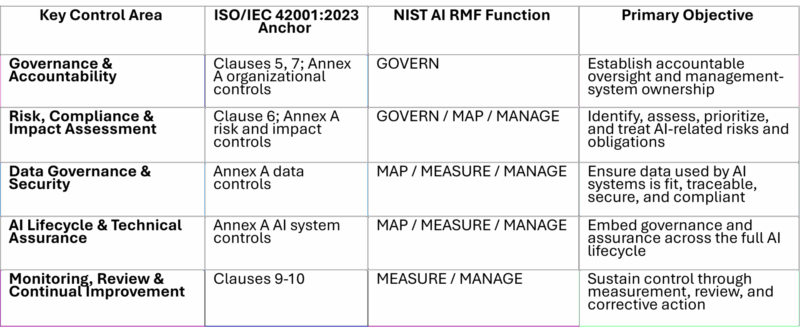
Core Governance Bodies and Policies
Standards define what good looks like; the following five elements operationalize governance. Together, they form the durable core of an AI governance architecture.[2]
AI Steering Committee
Effective governance requires a cross-functional body with clear accountability for AI-risk decisions. An AI Steering Committee should draw representation from IT security, legal and compliance, HR, business-unit leadership, and the office of the CISO or CRO. Its mandate covers approval of the AI vendor registry, review of AI incident reports, oversight of the acceptable-use policy, and escalation of material risks to the board audit committee. Without such a body, AI-risk decisions default to individual business units, creating inconsistency and accountability gaps. The committee need not be large or meet often; it needs clear ownership, documented authority, and a defined escalation path.
AI Acceptable-Use Policy
A published AI Acceptable-Use Policy (AUP) is the foundation of employee-facing governance. It should be specific, naming approved tools, prohibited categories of input data, and required behaviors, rather than aspirational. It should be written in plain language, updated as the tool landscape evolves, and surfaced at the point of use within approved tools, where feasible. Critically, the AUP should define what happens when an employee makes a mistake: a clear, non-punitive reporting path and a visible commitment to learning from near misses will materially improve incident detection.
AI Incident Response
Organizations need a defined AI incident-response process that covers detection, containment, forensic investigation, and regulatory notification. Forensic logging must be sufficient to reconstruct what data was submitted, to which service, and under which account. Playbooks should, at a minimum, address inadvertent disclosure of sensitive data to a consumer AI service, prompt-injection attacks against an AI-enabled application, and unauthorized AI use that could result in a breach. Notification procedures should be mapped to GDPR, CCPA, HIPAA, and state breach-notification statutes, because an AI-mediated disclosure of PHI, PII, or financial data may be notifiable regardless of intent.
Vendor AI Assessment Program and Approved-Tool Registry
Shadow AI is the enterprise equivalent of shadow IT, so the strategy must include a curated set of approved tools and documented data-handling agreements that make unsanctioned alternatives visible rather than merely prohibited. A structured vendor-assessment program prevents AI risk from entering through procurement. Standard questionnaires should cover data retention, training opt-out policies, sub-processor chains, encryption, access controls, breach-notification obligations, relevant certifications (SOC 2, ISO 27001, ISO 42001), and the vendor’s AI governance practices.[2]
A critical operational point: the enterprise tier of every major provider, including ChatGPT, Claude, and Gemini, offers data isolation, administrative controls, audit logging, and IP indemnification that consumer accounts lack. Ensuring employees use approved tools through corporate accounts is among the highest-return controls available. The registry should be reviewed at least annually, and any material change to a vendor’s data-handling terms should trigger immediate reassessment. [2]
Board-Level AI Risk Reporting
Security and privacy leaders should maintain a direct line to the board audit committee on AI risk. Reporting should cover three dimensions: control maturity (policy coverage, training completion, DLP deployment, vendor-assessment cadence, and red-team findings); the evolving threat and regulatory landscape; and incident data (near-misses, confirmed exposures, regulatory inquiries, and remediation status). Board visibility ensures the program is adequately resourced to match adoption velocity and anchors accountability at the governance level. As regulatory scrutiny intensifies, documented board oversight will itself become a material factor in examinations, audits, and litigation.
Governance Best Practices
Beyond bodies and policies, durable programs share a set of operating practices drawn from the consensus of leading practitioners. [26]
- Establish clear roles and ownership. Designate accountable individuals, an executive-level Chief Data or Chief AI Officer, supported by governance committees, data stewards, and model owners, and use RACI matrices to prevent accountability gaps in cross-functional projects.
- Build a data quality and lineage foundation. Machine-learning models amplify the quality of their training data. Set standards for representativeness, timeliness, and feature quality, and deploy end-to-end lineage that can be presented on demand to regulators and auditors, now an expectation under the EU AI Act.
- Conduct fairness audits and bias testing. Assess disparate impact across protected characteristics before deployment and at regular intervals and document results and remediation.
- Design human-in-the-loop checkpoints. For consequential decisions, credit, medical, and employment, specify which actions require human review, which thresholds trigger escalation, and how oversight is documented, consistent with EU AI Act requirements.
- Foster a culture of responsible AI. Technology and policy alone cannot deliver trustworthy AI; ongoing training, clear ethical guidelines, psychological safety to raise concerns, and visible leadership commitment are what make governance stick.
Common pitfalls are equally predictable: siloed data and AI teams that produce undocumented systems; treating governance as a one-time exercise even as models drift; regulatory fragmentation across jurisdictions; and legacy infrastructure that cannot support modern lineage tooling. A layered framework, NIST AI RMF, ISO 42001, ISO 27001, and the EU AI Act, mitigates each of these by providing a structured foundation that can scale as new requirements emerge. [3]
Conclusion
The regulatory environment for AI is tightening rapidly and simultaneously across jurisdictions, and the organizational response cannot be a separate workstream bolted on after the fact. Regulatory readiness and a risk-assessed governance architecture are the first two disciplines of a durable AI program because they create the accountability and alignment of standards that every downstream control depends on. AI governance is inseparable from data governance, and both are now competitive differentiators rather than mere compliance costs.
Organizations that treat governance as a dynamic discipline, revisiting controls as the threat landscape evolves, updating vendor assessments as provider policies change, and reporting AI risk to the board with the same rigor applied to financial and operational risk will be best positioned to capture AI’s productivity potential while protecting the IP that defines their advantage. Part 2 of this playbook turns to the human and technical disciplines that operationalize this foundation: security awareness and a layered technical defense.
References
1. reco.ai, 2025 State of Shadow AI Report. 2025: https://go.reco.ai/hubfs/2025%20Reco%20Shadow%20AI%20Report.pdf.
2. Ferrara, E., Protecting the Crown Jewels: AI Use Presents Real Risks, in Green Leaf Insights, M. Miner, Editor. 2026, Green Leaf Consulting Group.
3. Ferrara, E., AI Governance Is a Data Problem: How to Build Trustworthy AI at Scale, in Green Leaf Insights, N. Miner, Editor. 2026, Green Leaf Group: https://greenleafgrp.com/insights/ai-governance-is-a-data-problem-how-to-build-trustworthy-ai-at-scale/.
4. Cahill, J. and A.D. House, U.S. Artificial Intelligence Law Update: Navigating the Evolving State and Federal Regulatory Landscape, in Thought Leadership. 2026, Baker Botts: https://www.bakerbotts.com/thought-leadership/publications/2026/january/us-ai-law-update.
5. Commission, E. AI Act: Shaping Europe’s digital future. 2026 [cited 2026 May 30]; Available from: https://digital-strategy.ec.europa.eu/en/policies/regulatory-framework-ai.
6. (ISO/IEC), I.S.O., ISO-42001:2023 — Information technology — Artificial intelligence — Management system. 2023, International Standards Organization: https://www.iso.org/standard/42001.
7. ISO/IEC, ISO 27001:2005(E) Information Technology – Security Techniques – Information Security Management Systems – Requirements. 2005, ISO/IEC: Geneva, Switzerland.
8. Standards, N.I.o., Artificial Intelligence Risk Management Framework (AI RMF 1.0). 2023, National Institute of Standards (NIST): https://nvlpubs.nist.gov/nistpubs/ai/NIST.AI.100-1.pdf.
9. Nadkarni, A. and D. Pearson, Scaling Enterprise AI Responsibly: The Critical Role of Data Readiness and an Intelligent Data Infrastructure, in InfoBrief. 2025, IDC & NetApp: https://www.netapp.com/media/142474-idc-2025-ai-maturity-findings.pdf.
10. Trump, D.J., Executive Order: Initial Rescissions Of Harmful Executive Orders and Actions, O.o.t. President, Editor. 2025, The White House: https://www.whitehouse.gov/presidential-actions/2025/01/initial-rescissions-of-harmful-executive-orders-and-actions/.
11. Trump, D.J., Executive Order: Ensuring a National Policy Framework for Artificial Intelligence, T.W. House, Editor. 2026, The White House: https://www.whitehouse.gov/presidential-actions/2025/12/eliminating-state-law-obstruction-of-national-artificial-intelligence-policy/.
12. Rozen, C. and D. Shepardson US House lawmakers release draft bill to prohibit state AI rules. Reuters, 2026.
13. Withers, B.P. and R. Moussa, Federal AI Moratorium Dies on the Vine as Senate Passes the One Big Beautiful Bill Act, in Goodwin Insights. 2026, Goodwin: https://1npdf11.onenorth.com/pdfrenderer.svc/v1/abcpdf11/GetRenderedPdfByUrl/alerts-practices-aiml-federal-ai-moratorium-dies-on-the-vine.pdf/?url=https://www.goodwinlaw.com/pdf%2Fen%2Finsights%2Fpublications%2F2025%2F07%2Falerts-practices-aiml-federal-ai-moratorium-dies-on-the-vine.
14. Mazariego, J., Healthcare AI Regulation Compliance Guide, in Healthcare Industry Legal Blog. 2026, Jimerson Birr: https://www.jimersonfirm.com/blog/2026/02/healthcare-ai-regulation-2025-new-compliance-requirements-every-provider-must-know/.
15. Hrdy, A.S., et al., CFPB Warns of FCRA Implications Associated with the Use of Workplace Tracking Technology, in Morgan Lewis: Our Thinking. 2024, Morgan Lewis: https://www.morganlewis.com/pubs/2024/11/cfpb-warns-of-fcra-implications-associated-with-the-use-of-workplace-tracking-technology.
16. Welle, L.J., et al., The Evolving Landscape of AI Regulation in Financial Services, in Goodwin Alert. 2026, Goodwin: https://1npdf11.onenorth.com/pdfrenderer.svc/v1/abcpdf11/GetRenderedPdfByUrl/alerts-finance-fs-the-evolving-landscape-of-ai-regulation.pdf/?url=https://www.goodwinlaw.com/pdf%2Fen%2Finsights%2Fpublications%2F2025%2F06%2Falerts-finance-fs-the-evolving-landscape-of-ai-regulation.
17. Commission, F.T., Press Release: FTC Order Requires Workado to Back Up Artificial Intelligence Detection Claims, F.T. Commissiion, Editor. 2025.
18. Stone, K.E., W.M. Carlucci, and B. Castro, DOJ Intervenes in Lawsuit Challenging Colorado’s ‘Algorithmic Discrimination’ Law, in Alerts. 2026, Barnes & Thornburg: https://btlaw.com/en/insights/alerts/2026/doj-intervenes-in-lawsuit-challenging-colorados-algorithmic-discrimination-law.
19. Pitch, AI Act Meets GDPR: Where the Two Frameworks Overlap. 2026, Pitch: https://www.pitch.law/knowledge-base/ai-act-meets-gdpr-where-frameworks-overlap.
20. Institute, I.S., ISO/IEC 27001 – Information technology — Security Techniques — Information security management systems — Requirements. 2013.
21. Huang, K., EU AI Act vs NIST AI RMF vs ISO IEC 42001 A Plain English Comparison. 2026.
22. Agency, U.S.C.a.I.S., et al., Principles for the Secure Integration of Artificial Intelligence in Operational Technology, U.S.C.a.I.S. Agency, et al., Editors. 2025: https://www.cisa.gov/sites/default/files/2026-01/joint-guidance-principles-for-the-secure-integration-of-artificial-intelligence-in-operational-technology-508cV2.pdf.
23. Lauren, K., Global AI Regulations Fuel Billion-Dollar Market for AI Governance Platforms, in Gartner – News Room. 2026, Gartner: https://www.gartner.com/en/newsroom/press-releases/2026-02-17-gartner-global-ai-regulations-fuel-billion-dollar-market-for-ai-governance-platforms.
24. Optro, Human.Behavior: The AI Risk Surface GRC Can’t Ignore. 2026, Optro: https://optro.ai/resources/ebook/human-behavior-the-ai-risk-surface-grc-cant-ignore#form.
25. Chaudhary, A., Use ISO 42001 & NIST AI RMF to Help with the EU AI Act, in Industry Insights. 2025, Clod Security Alliance: https://cloudsecurityalliance.org/blog/2025/01/29/how-can-iso-iec-42001-nist-ai-rmf-help-comply-with-the-eu-ai-act.
26. Schmelzer, R. and K. Kathleen Walch, AI Data Governance Best Practices for Security and Quality, in PMI Blog. 2025, Project Management Institute (PMI): https://www.pmi.org/blog/ai-data-governance-best-practices.